
Where Is Tersane Island, How to Get There? Göcek
_1600.webp?alt=media)
Where Is Tersane Island?
Tersane Island lies in Fethiye district, Muğla province, in the western part of Fethiye Bay — just off Göcek — and is the largest island in the bay. It's part of the archipelago known as the "Göcek 12 Islands." The island takes its name from the shipbuilding and repair work carried out here in Ottoman times; the deep, sheltered cove on its northern side formed an almost natural shipyard for the job. There's no settlement on the island today — only the stone houses of an abandoned village remain. There's no road access. Short answer: Tersane Island belongs to Fethiye, is about half an hour from Göcek by boat, and can only be reached by sea.
Which Province and District Is Tersane Island In?
The island belongs to Fethiye district, Muğla province. The nearest settlement is Göcek, a town within Fethiye. It's also the most practical departure point for the island; the crossing takes a bit longer for those setting off from central Fethiye.
The nearest airport is Dalaman Airport (DLM). It's a 20-25 minute drive from the airport to Göcek, and about another half hour by boat from there to the island — meaning you can land and be anchored in the island's bay the same day.
How to Get to Tersane Island
There's no road to the island; access is entirely by sea.
- From Göcek: This is the most common route. For daily tours and private charters departing from Göcek harbor, the island is a comfortable half-hour cruise away.
- From Fethiye: You cross Fethiye Bay heading west; the crossing takes one to two hours and passes the bay's other islands along the way.
- On a weekly route: On most Blue Cruise routes departing from Göcek and Fethiye, the island is one of the overnight stops in the first few days. The island's boat guide page describes anchoring conditions from this perspective.
What Is Tersane Island Known For?
The shipyard history behind its name
The bay on the island's northern side has a narrow entrance, deep inner waters, and surrounding slopes that shelter it on all sides. This setup made it an ideal spot for building and maintaining ships in the age of sail. The island takes its name from this history, and traces of old structures can still be seen around the bay.
The abandoned Greek village
Until the early 20th century, the island had a Greek settlement. It emptied out with the population exchange, leaving behind stone houses, courtyard walls, and the remains of a place of worship. Today, walking among these ruins is the island's most popular activity. The structures are crumbling and unmaintained, so avoid leaning on the walls, stay out of roofless buildings, and wear closed shoes.
Wandering through the ruins takes about half an hour, and the island is one of the few spots in Göcek Bay where you can walk in the shade. Even in the height of summer, it stays cool beneath the pine cover, so you can spend the midday heat among the trees instead of on the shore.
Its sheltered bay
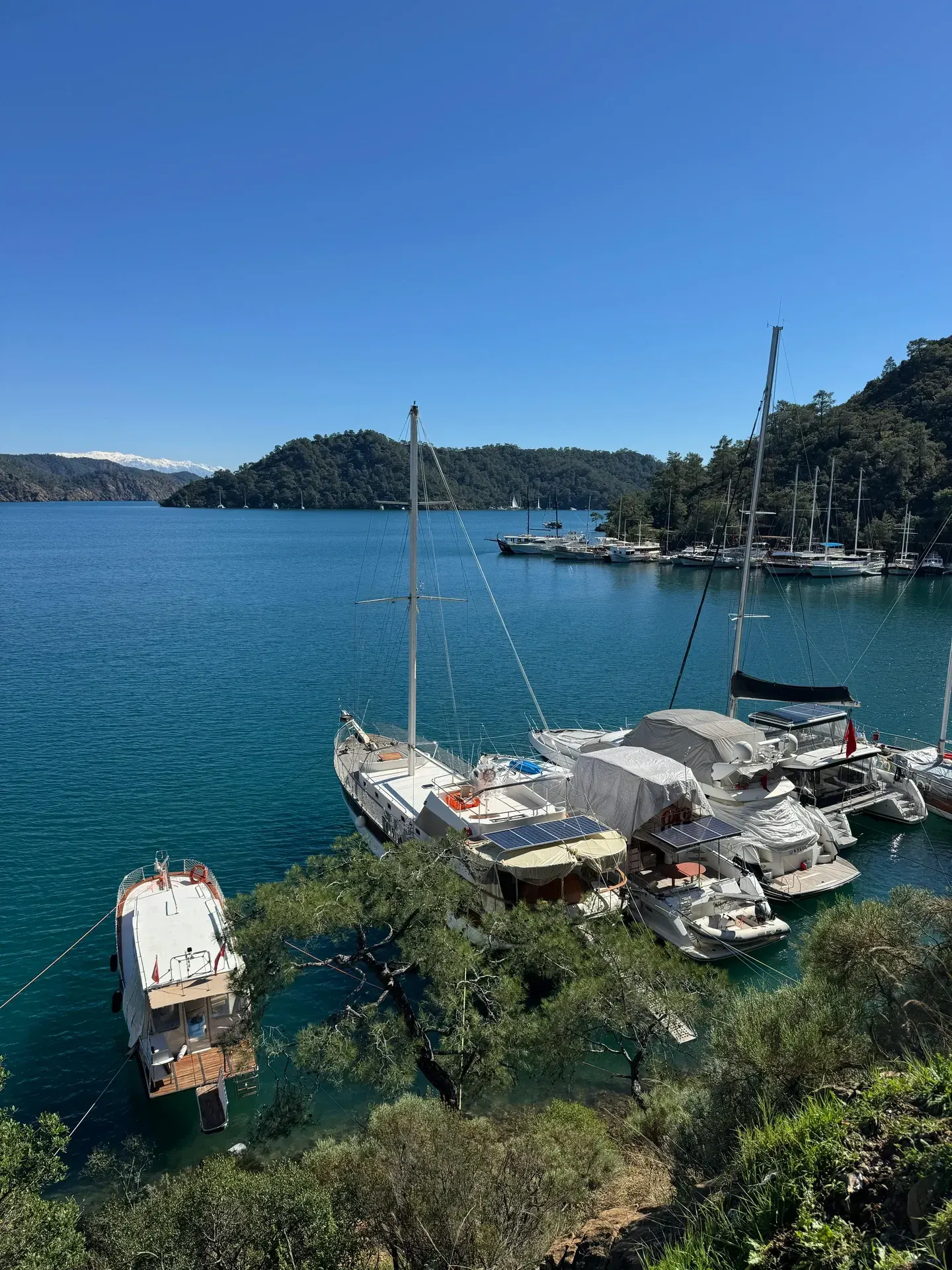
Tersane Bay is one of the safest overnight anchorages in Göcek Bay. Its narrow entrance and surrounding slopes shield it from the wind, so the water stays calm in almost any conditions. The bay has a handful of restaurants with their own jetties, where boats tie up. The region's usual arrangement applies here too: you eat dinner at the restaurant, and in return you get a spot on its jetty.
Jetty space is limited and fills up by late afternoon in midsummer. Captains typically book a spot in advance or arrive early. If no jetty space is available, anchoring in the bay is also an option — the water is deep, and tying a line to shore is a common method in the region.
Can You Swim at Tersane Island?
Yes. The bay is deep and clear, while the shore is made of pebbles and rock, so don't expect a sandy beach. Swimming here happens off the boat's ladder rather than from the shore. This is also what families with children love about it: no waves, no current, and the boat is always just a step away.
Because the bay is enclosed, the water is a little warmer than on the open coast and waves are almost nonexistent. This makes it a great spot for paddleboarding, kayaking, and long swims. On the island's outer shores, the water is cooler and choppier.
When Should You Go?
The season runs from late May to early October. July and August are the busiest months; since jetty space in the bay is limited, it's best to settle on your overnight spot early during these months. June and September offer the best balance of weather and crowds.
There's no shop, pharmacy, or regular transport on the island, so stock up on what you need in Göcek beforehand. Since you'll be anchoring overnight in a wooded bay, mosquito repellent should be at the top of your packing list. Mobile phone signal is patchy in places.
How Does It Differ from Yassıca?
Both islands belong to the same archipelago, but their characters are opposite. The Yassıca Islands are low, treeless, and very shallow — the island of turquoise water and daytime breaks. Tersane, on the other hand, is large, wooded, and deep, with shade, history, and a sheltered bay. That's why a typical day in Göcek combines both: swimming at Yassıca by day, anchoring overnight at Tersane.
Another stop frequently added to the route is Bedri Rahmi Bay, known for the fish figure that painter Bedri Rahmi Eyüboğlu drew on its rocks — one of the most recognizable landmarks in Göcek Bay.
Tersane Island on the Göcek Route
The first days of a weekly route out of Göcek are mostly spent within the bay. For the town itself and the anchorages around it, the Göcek boat guide page gives a general overview; for the full route, see the Blue Cruise from Göcek page.
If you'd like the boat entirely to your own group, the Göcek yacht charter options list gulets, motor yachts, and catamarans on a single page. Göcek's advantage is that all these stops can be visited without ever heading out into open water — calm seas, short distances, and a sheltered bay every night.
Tersane's role in the route grows out of this. There's no tiring stretch to the day: a boat leaving Göcek in the morning reaches the island before noon, spends the afternoon swimming and exploring the ruins, and has dinner at the jetty in the evening. For first-time sailing guests, this is the gentlest way to ease into life at sea; for seasoned ones, it's the bay's most dependable shelter.
Frequently Asked Questions
<strong>Which province is Tersane Island in?</strong> It's in Muğla province, within Fethiye district. It sits in the western part of Fethiye Bay, just off Göcek, and is the bay's largest island.
<strong>Where does Tersane Island get its name from?</strong> During Ottoman times, ships were built and repaired in the sheltered bay on the island's northern side. The island takes its name from this shipyard history.
<strong>Can you reach Tersane Island by land?</strong> No. The island has no road access; it can only be reached by sea. It takes about half an hour by boat from Göcek.
<strong>What is there to see at Tersane Island?</strong> There are stone house and building ruins from an abandoned Greek village, the sheltered Tersane Bay, and a handful of restaurants with jetties in the bay. Since the ruins are unmaintained, take care while exploring and wear closed shoes.
_1600.webp?alt=media)
_1600.webp?alt=media)